I’ll admit it. I wasn’t entirely jazzed about taking a class on entrepreneurship. While I recognize the usefulness of entrepreneurial skills for journalism students, I’m not sure that I’m cut out for it. First of all, there was a whole lot of business jargon that mostly went over my head. Also, it involves finances, so yeah…
So, what do you do with a class that you are not cut out for? You start thinking about the people around you, and you appreciate the community you have. At least, this is what I did. Even though I’m not a business person, I still enjoyed the class because I had a really cool professor and some really great classmates.
Thanks for a fun semester, Carol. I’m bummed it’s my last class with you, but I’ll still see you next semester.
Free photo from unsplash.com – This photo of crowdfunding materials is by Rawpixel from unsplash.com, licensed under Creative Commons Zero.
In many ways, the way that a crowdfunding page is presented is just as important as the actual idea somebody is fundraising for. I’m positive there are many great and groundbreaking ideas that have been developed, but because these ideas have not been presented properly, they have received insufficient financial backing.
Because the ultimate goal is to persuade someone that your product is a worthwhile investment, it is important to be clear and precise with how you communicate your business and product. Clarity is probably the most important element of persuasion. In the case of crowdfunding, it is the obligation of the entrepreneur to be clear about how their product solves a specific problem. Additionally, they have an obligation to be clear about how supporting their idea is a good investment.
When a product or an idea is presented well, something clicks with its audience. The audience members might actually consider a time when the idea or product would have been useful to them. The objective is to reach this level of persuasion: for the prospective customer or investor to recognize the need for the product. This makes it that much easier to convince someone to support the business.
There is also the possibility that all the ideas and aspects of a product were communicated efficiently, but there was nothing actually attractive about the presentation. This is where style comes in. It is important to be able to not only be clear about what your saying but also do it in a way that appeals to people.
This brings us to the two examples for Kickstarters. The first, which is for The Coolest, offers a very slick and easy-to-watch video. You get the idea of exactly how the product differentiates itself and might be useful to a customer. This Kickstarter excels at providing compelling information on the features The Coolest offers. The other Kickstarter video, for the MudTails apparel, is messy. The video footage is not oriented correctly to fit the format, the audio is kind of awkward, and the message is unclear. A few things that would have helped the video is if there were music playing throughout the video and if they used a different narrator. It is important for a narrator to speak very clearly, in a presentational manner. This narrator could not do that.
One final thing that I thought The Coolest video could have done better is that it should have been more clear and more upfront about how proceeds to the entrepreneur would be used. They spent a lot of time on the product and not enough time on the need for support.
When I started working on my elevator pitch, I knew that I wanted it to be brief and to the point. When we started watching some of the examples of elevator pitches, it seemed that they often got bogged down by statistics. This is not to say that I think statistics are bad or that they are pointless. On the contrary, they help support the pitch and give it legitimacy. What I didn’t want to happen with my pitch is for it to lose its focus; I didn’t want to cite statistics for the sake of citing them – they actually had to support what I wanted to say.
When it came down to it, I didn’t really end up using any statistics. I felt like I could communicate what I wanted to say to the audience if I helped them understand the need for the product and how our product is unique compared to others that are similar. Because of this, I really worked on making sure the explanation of the product was clear.
I was actually happy that I got to work on a presentation like this because I feel like this is one of my strong suits. Between participating in speech and being in theater productions, I have had experience speaking in front of audiences for most of my life. This is why I was somewhat surprised to find myself as nervous as I was; there are a few things that contributed to this.
The first is that the presentation had to be memorized. Now, I knew this was something that I could do (because I’ve done it so many times before), but I have been out of practice: I haven’t had to memorize something for a presentation (or a play) in a long time. I think because so much of the presentations I have had to give in college are more impromptu or casual, I felt more pressure to be precise with how I presented this pitch.
The second main thing that contributed to my nervousness is the fact that I had to give this pitch to my peers. Throughout my life as a speaker and performer, I’ve always found that presenting for people you know is much harder than presenter for strangers. I guess that I just forgot how it felt to get in front of your peers and recite a memorized presentation.
The final thing that contributed to my nerves was the nervous energy surrounding this presentation. We talked a little about this in class, but I feel like I wasn’t as nervous about it until we started talking about how nervous people got during their presentations. I think it was hyped up so much that it really started to make me nervous about it.
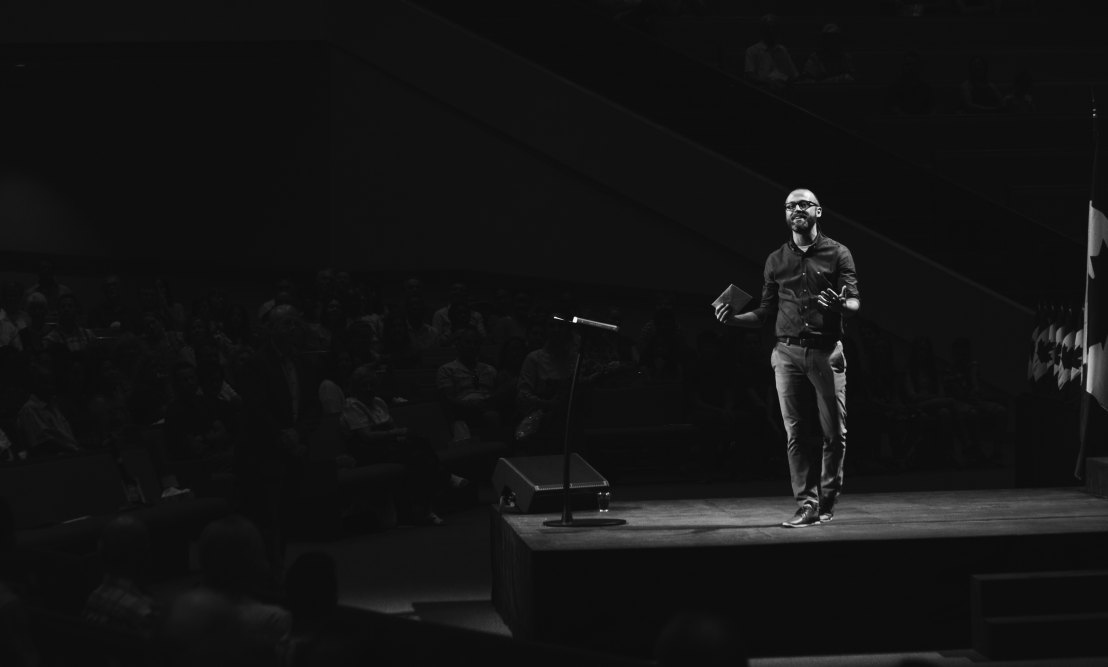
Free photo from unsplash.com – This photo of a man walking across a stage is by Hermes Rivera from unsplash.com, licensed under Creative Commons Zero.
One thing that I really liked about this assignment was being able to see my classmates present. There is no question that everyone was at least a little nervous for this pitch. And even though some of us may not have wanted to give this pitch, it was really cool to see people step out of their comfort zones. Along with this, I love seeing how supportive everyone is of a student that is struggling through his or her presentation. This sort of thing just goes to show that there’s nothing really to worry about. Although our friends and peers might make us the most nervous, they’re also the most supportive.
Free photo from unsplash.com – This photo of a shovel, a pitch fork, and a rake is by Nastya Kvokka from unsplash.com, licensed under Creative Commons Zero.
When I was 7 years old, I wanted to start a business where I dug holes in people’s backyards. I was heavily inspired by the movie Holes that had come out around that time. I wanted to be just like the kids in the movie. I decided to start off my business by digging a hole in my own (my parents’) backyard. Suffice to say my parents weren’t pleased. Upon their discovery of a shallow and wide hole in the middle of the green grass, all future plans of becoming a professional hole digger went out the window. I realized then at that formative age that I never really figured out if my parents – or anyone for that matter – actually wanted a hole dug up in their yard. The answer is almost always a definitive “no.”
Besides being a dumb little story from my childhood, this anecdote really demonstrates the benefit of using the lean business method. If I had made an effort to communicate with potential customers on whether or not they actually needed a hole-digging service, I would have had a greater possibility of developing an idea that could be successful (but let’s be real – I was a kid and I just wanted dig them holes). This is one of the main things about Blank’s article that I found so interesting: The lean method produces fewer failures than other traditional start-up methods.
If this is the case, then it would seem like everyone would want to embrace this approach. I think what it comes down to is that entrepreneurs using the waterfall method think they know what customers want, and that’s why they spend so much time developing their plan. One would think that after years of failed business plans as evidence, an entrepreneur might take a hint that no one knows their customers as much as they think they do.
This is why the idea of the lean method seems not only successful but appealing as well. There seems to be a constant line of communication between the entrepreneur and the consumer which ultimately helps create a better product. After all, businesses are about solving problems, and nothing gets to the core of someone’s problems like addressing it head on and asking how it can be fixed.
 I’ll admit it. I wasn’t entirely jazzed about taking a class on entrepreneurship. While I recognize the usefulness of entrepreneurial skills for journalism students, I’m not sure that I’m cut out for it. First of all, there was a whole lot of business jargon that mostly went over my head. Also, it involves finances, so yeah…